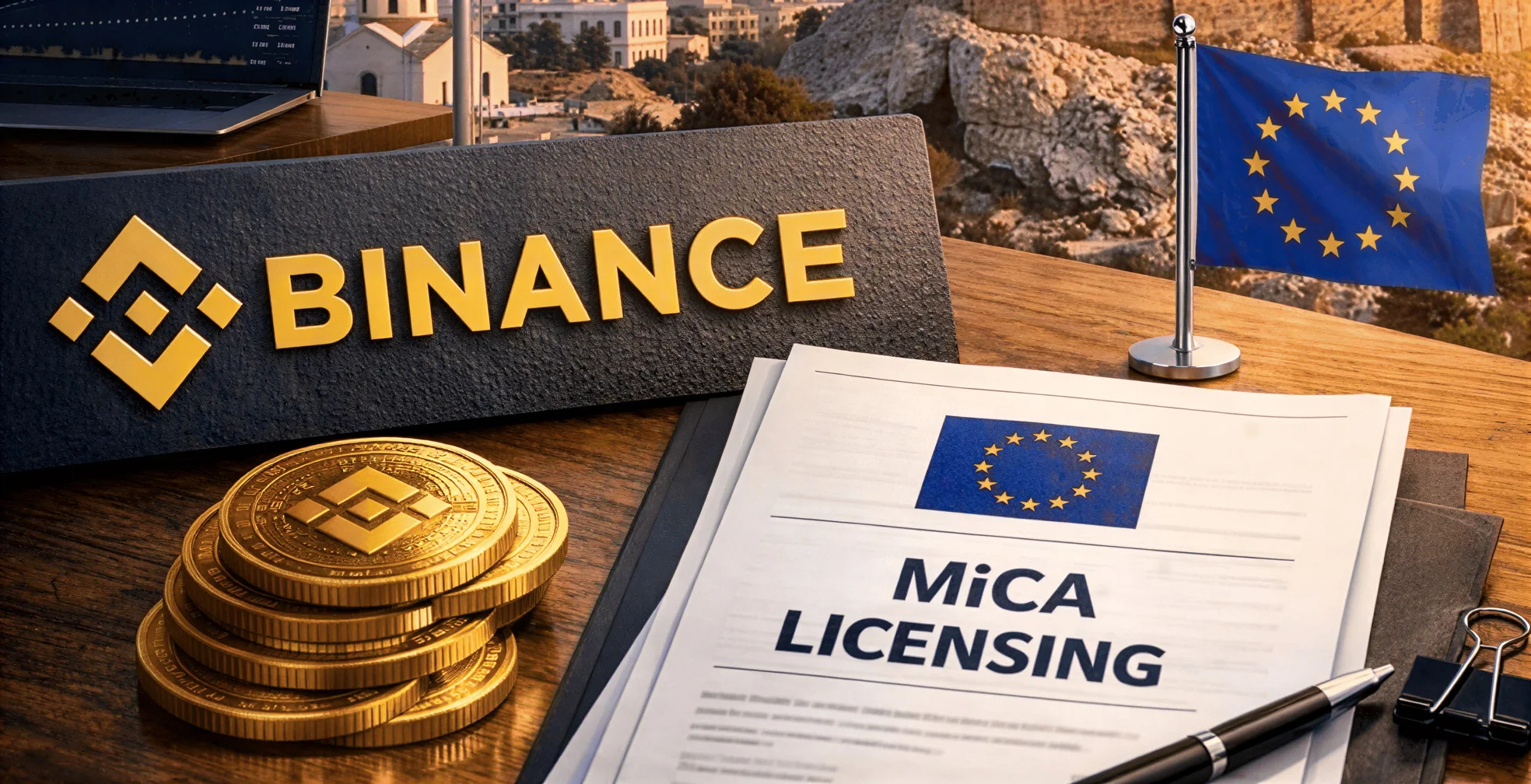
Binance has taken a decisive step to secure its position in the European market by applying for an EU-wide crypto license under the Markets in Crypto-Assets (MiCA) framework, with Greece chosen as its regulatory base.
The world’s largest cryptocurrency exchange has established a local holding entity, Binance Greece, and formally submitted its MiCA license application to Greek authorities.
Once approved by the Hellenic Capital Market Commission, Binance would be permitted to operate and market crypto services across all European Union member states.
Greece Becomes Binance’s Regulatory Gateway to Europe
Greece has become Binance’s main regulatory entry point into Europe as the crypto exchange works toward full MiCA approval. Binance has officially set up a new holding company called Binance Greece, structured as a single-shareholder public limited company with an initial capital of €25,000.
The company will be responsible for managing Binance’s equity investments in Greece and other countries. It will also provide advisory services, including guidance on investment planning, capital structure, and liquidity management.
Binance Greece will be led by Gillian Majella Lynch, the exchange’s Head of Europe and the UK. She brings strong leadership experience from banking, fintech, and the cryptocurrency industry, supporting Binance’s push for regulatory compliance across Europe.
MiCA Deadline Forces Crypto Firms to Act
Binance’s move comes as regulatory pressure intensifies across Europe. The MiCA regulation, fully enforceable since December 2024, requires all crypto platforms operating in the EU to obtain authorization by July 1, 2026.
Firms that fail to comply risk losing access to the European market altogether. Regulators have already signaled strict enforcement.
In France, inspections by the banking regulator ACPR revealed weaknesses in risk control systems at several crypto firms, while anti-money laundering reviews continue across dozens of exchanges.
Of more than 100 crypto platforms registered in France, only a handful have secured full approval so far.
Competition Heats Up as Licenses Roll Out
Major crypto exchanges such as Coinbase, Kraken, OKX, Bybit and KuCoin have already received MiCA licenses or are close to launching fully regulated services across the European Economic Area.
At present, more than 50 crypto firms hold MiCA approval, putting strong pressure on remaining platforms to meet the new rules or risk losing market access.
Regulators are making it clear that there will be little flexibility going forward. Italy’s financial regulator Consob recently confirmed that crypto companies operating under older registration rules can continue their activities only until June 30, 2026.
After that date, firms without proper authorization will be forced to exit the market, making compliance urgent.
Stablecoin Market Sees Consolidation
MiCA compliance is changing Europe’s stablecoin market in a big way. Some companies are moving ahead, while others are falling behind.
Tether, the largest stablecoin issuer, has not yet received approval under MiCA rules and has already been removed from several EU exchanges.
On the other hand, companies like Circle, Société Générale Forge, and Membrane Finance have successfully secured licenses to operate in Europe. Most of their approved stablecoins are backed by the euro, not the US dollar.
This shows that Europe is clearly shifting toward regulated, euro based digital assets. As rules become stricter, only compliant and transparent stablecoin issuers are likely to survive and grow in the European crypto market.
Binance Looks Ahead With Optimism
Binance remains optimistic despite increasing regulations in Europe. The company’s co-CEOs, Yi He and Richard Teng, highlighted key factors that will support long-term growth, including clearer rules for crypto, growing interest from institutions, government-level adoption of digital assets, and the rise of enterprise applications.
With the MiCA deadline approaching in July 2026, Binance’s application for a crypto license in Greece shows its commitment to full compliance.
The move ensures the exchange can continue operating across the European Union while strengthening its position as a leading player in the fast-growing European crypto market.