

Riot Platforms sold 3778 Bitcoin in the first quarter of 2026, earning about $289.5 million. This amount is 2.6 times higher than the 1,473 BTC the company mined during the same period, showing a major shift in its strategy.
At the end of Q1, Riot still held 15,680 BTC, down 18% from 18,005 BTC at the end of 2025. Blockchain intelligence platform Arkham reported an additional 500 BTC outflow from a wallet linked to Riot, suggesting the company continued selling even after the quarter ended.
Experts say Riot’s move is not just about covering costs. The company is investing in high-performance computing and infrastructure hosting, which requires capital.
Rising energy costs are another reason for the sales, as mining expenses have increased. Overall, Riot’s actions reflect a strategic reallocation of resources, balancing operational needs with market pressures while preparing for the future.
Strategic Pivot Beyond Mining
Riot Platforms is moving beyond just Bitcoin mining and focusing on high-performance computing (HPC) colocation, which means hosting powerful computer systems for other companies. This shift requires a lot of money, which partly explains why Riot sold a large amount of Bitcoin in Q1 2026.
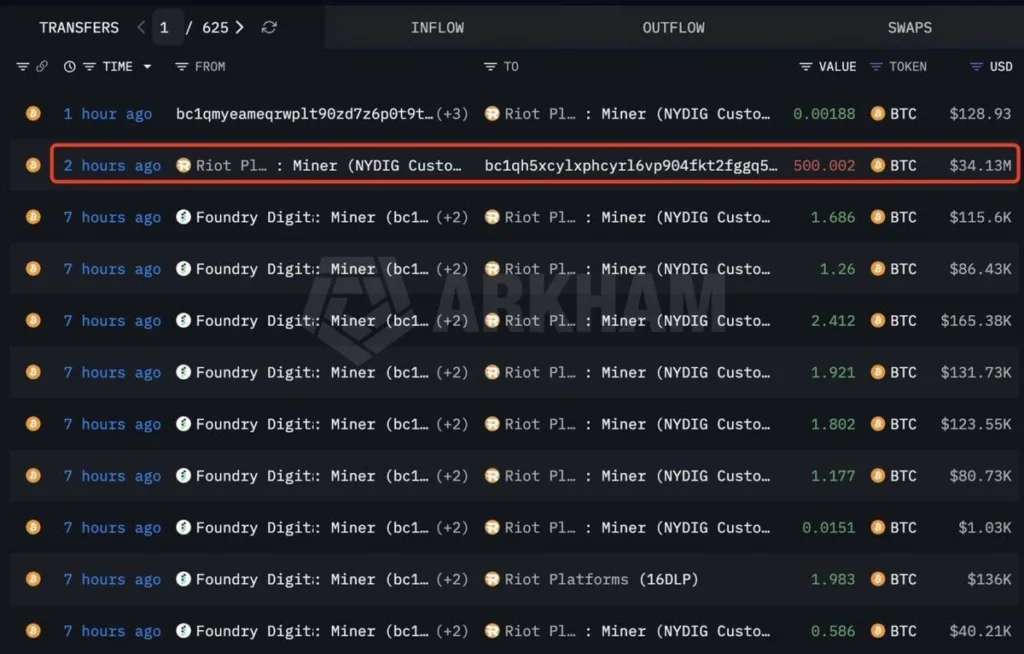
At the same time, rising energy costs, worsened by tensions in the Middle East are making mining more expensive. Many miners are selling their Bitcoin to cover costs or adjust their strategies.
Kadan Stadelmann, blockchain developer and AI expert at Compance, says that higher energy costs reduce miner profits, causing some to sell. This temporarily lowers the network’s mining activity, which can benefit miners like Riot who continue operating efficiently.
Selling Above Production: Strategy or Trouble?
Riot Platforms sold 2.6 times more Bitcoin than it mined in Q1 2026. This is not normal treasury management; it shows the company is reallocating capital to fund bigger projects rather than just covering costs.
The numbers support this view. Riot’s power cost dropped 21% year over year to 3.0¢/kWh, while its hash rate grew 26% to 42.5 EH/s. The company also earned $21 million in power credits, more than double last year’s Q1.
These improvements show Riot is not struggling. Instead, it is strategically using its resources to expand mining infrastructure and strengthen operations, making the company more resilient in a changing market.
Industry-Wide Shift in Bitcoin Mining
Riot Platforms isn’t the only miner selling large amounts of Bitcoin. MARA Holdings, Genius Group and Nakamoto Holdings sold a total of 15,501 BTC in just one week.
Genius Group went even further by selling all of its Bitcoin holdings, showing that miners are moving away from simply holding Bitcoin to actively managing their cash and treasury.
This change reflects a major shift in the crypto mining industry, where companies are balancing profits, operating costs and investments in infrastructure.
If Bitcoin prices do not bounce back in Q2 2026, Riot’s Bitcoin reserves could drop further, potentially reaching 14,000 BTC within the next two quarters, continuing the trend of strategic sales.
Impact on Bitcoin Supply and Market Trends
Bitcoin mining difficulty dropped from 145 trillion to 133 trillion on March 20, a 7.7% decline, while the network hash rate fell from 1,160 EH/s to 990 EH/s. This means weaker miners are going offline, allowing stronger miners like Riot to benefit from easier mining and higher rewards per block.
On the demand side, Bitcoin ETFs helped absorb some of the extra supply, with $1.32 billion in March inflows reversing a four-month outflow streak.
Although Riot alone cannot move BTC prices, the combined sales by Riot, MARA, Genius and Nakamoto create noticeable market pressure, which is reflected in miner outflow data.