

Ethereum has recorded its strongest network activity to date processing 200.4 million base-layer transactions in Q1 2026, crossing the 200 million mark for the first time in a single quarter.
This milestone highlights a strong recovery in on-chain usage after years of slower activity, driven by increased adoption of Layer 2 networks and stablecoin settlements.
However, despite this surge in network fundamentals, ETH price performance remains weak and largely disconnected from its growing ecosystem activity.
Ethereum Activity Hits All-Time High
Ethereum network activity has reached its highest level ever. According to on-chain data, transaction volume increased from about 90 million in 2023 to over 200 million in Q1 2026, showing a strong U-shaped recovery in usage.
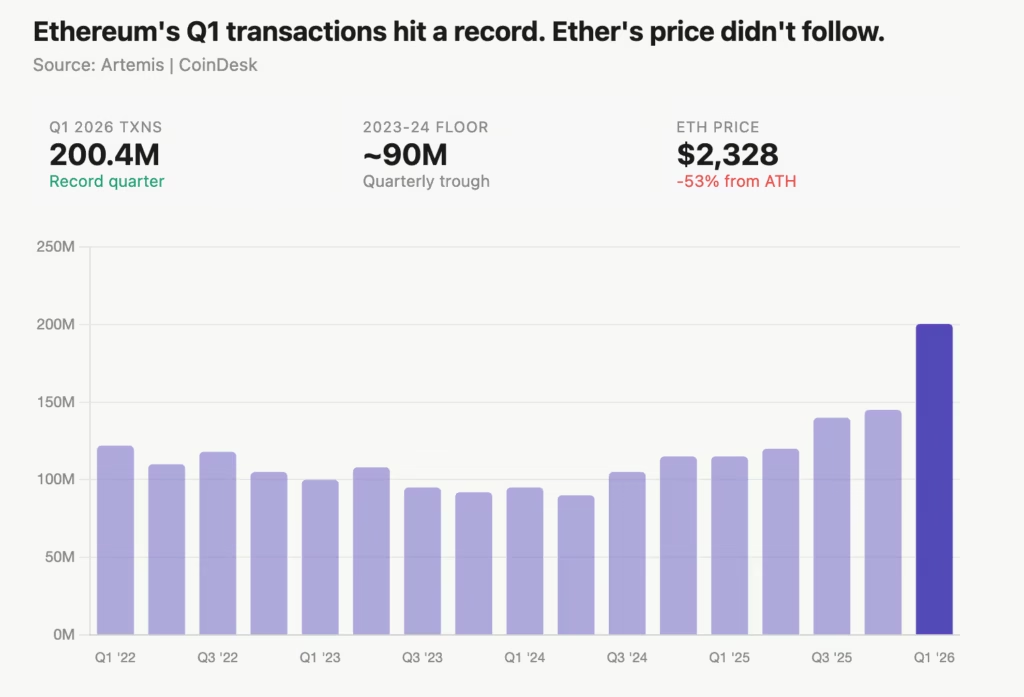
Source: Coindesk
During 2024, activity stayed mostly between 100–120 million transactions per quarter, but things started improving in mid-2025 as more users returned to the network.
This growth shows that Ethereum is being used more for decentralized apps, token transfers, and smart contracts. In simple terms, more people and systems are actively using Ethereum for digital transactions than ever before.
The rise highlights strong network demand, even as the broader crypto market continues to face price fluctuations.
Price Weakness Despite Strong Fundamentals
Ether (ETH) price is still under pressure. It is trading around $2,300, which is more than 50% lower than its peak near $5,000 in August 2025.
This shows a clear gap between Ethereum’s real usage and its market price. Even though more people are using the network and transactions are at record highs, the ETH token has not followed the same growth.
Many analysts find this unusual because normally higher usage supports price growth. However, in Ethereum’s case, increasing activity is mainly driven by Layer 2 networks and stablecoins, which does not always increase ETH demand directly. This is why fundamentals are improving, but price remains weak.
Layer 2 Networks Drive Majority of Growth
Layer 2 networks like Arbitrum and Base are playing a big role in Ethereum’s growth. These systems process transactions outside the main Ethereum blockchain at much lower costs and then send the final results back to Ethereum for settlement.
This makes the network faster and cheaper to use. However, not all activity happens directly on Ethereum’s main layer anymore.
Instead, much of it is handled off-chain and only recorded later. While this improves scalability and user experience, it also changes how value and transactions are distributed across the Ethereum ecosystem, reducing direct activity on the base layer.
Stablecoins Strengthen On-Chain Activity
Stablecoins are playing a big role in increasing activity on the Ethereum network. Their usage has grown quickly in recent years, making Ethereum one of the main platforms for stablecoin transactions.
The total value of stablecoins on Ethereum has reached around $180 billion, which is about 60% of all stablecoins in the global market. These digital tokens are popular because they are linked to stable assets like the US dollar, making them less volatile.
People use stablecoins for payments, trading, and decentralized finance (DeFi) apps. This rising usage is helping increase transaction activity across the Ethereum ecosystem.
Post-Dencun Fee Dynamics Impact Revenue
After Ethereum’s Dencun upgrade, fees for Layer 2 networks became much cheaper. This made transactions faster and more affordable for users, improving overall scalability.
However, lower fees also reduced the amount of revenue generated on Ethereum’s main network (base layer). Because of this, even if the number of transactions increases, it does not always lead to higher ETH burning or increased earnings for token holders.
In simple terms, Ethereum is now handling more activity, but it is earning less from each transaction. This has changed how value flows in the Ethereum ecosystem and created a new network economic structure.
Market Outlook: Growth vs Price Gap
Ethereum’s network is growing fast but its price is not moving the same way. This creates a clear gap between usage and value. Some experts believe that higher adoption usually comes before a price increase, meaning ETH could rise later if growth continues.
However, others think the activity may not fully reflect real user demand, as much of it comes from Layer 2 networks and stablecoin transfers. These factors increase transaction numbers but not always direct value for ETH holders.
The next quarter will be important to see if this growth continues or slows down.