
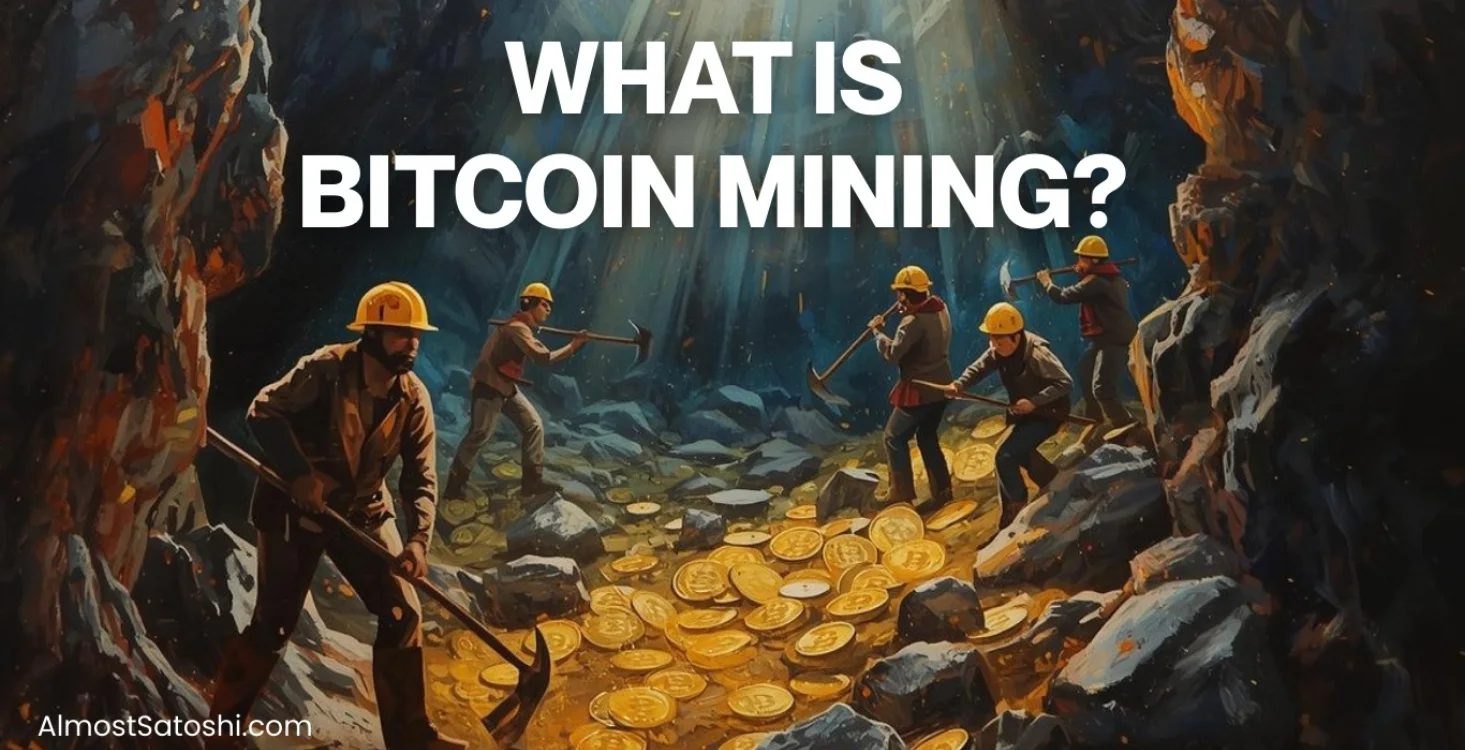
Bitcoin mining is the system that keeps the Bitcoin network working smoothly. It uses powerful computers to solve complex math problems that confirm transactions and record them on a public digital ledger.
When miners successfully complete this work, they receive rewards in the form of new Bitcoin and transaction fees. This process helps keep the network secure, transparent, and decentralized, meaning no single person or organization controls it.
If you have ever wondered what is bitcoin mining, why it is important, and how people earn Bitcoin through it, the idea is actually simpler than it sounds. Mining is how transactions get verified, how new coins are created, and how the entire Bitcoin system stays trustworthy.
In this guide, you will learn the basics in clear, easy-to-understand language, even if you are completely new to blockchain technology.
What Is Bitcoin Mining?
Bitcoin mining is the process that helps keep the Bitcoin network running safely. Instead of digging for gold, miners use powerful computers to solve complex math problems. When a miner solves one of these problems, they are allowed to add a new group of transactions to the Bitcoin record.
Many people think mining bitcoins means just creating new coins, but that is not the full story. Miners also check and confirm Bitcoin transactions. Whenever someone sends or receives Bitcoin, the transaction must be verified. Mining is what makes sure those transactions are real and secure.
Some beginners search for what is bit mining, which means the same thing. It is the process of using computer power to protect and maintain a digital money system that no single person or company controls.
Why Is Bitcoin Mining Important?
Bitcoin mining plays several critical roles:
1. Transaction Verification
Every time someone sends Bitcoin, the network needs to make sure they actually own the coins. Miners check each transaction carefully to confirm it’s valid and not a duplicate.
This process, called transaction verification, prevents fraud like spending the same Bitcoin twice. By verifying transactions, miners keep the network secure and ensure that everyone’s Bitcoin balances remain accurate.
2. Network Security
Bitcoin mining keeps the network safe from fraud and attacks. Miners use powerful computers and electricity to solve complex puzzles. This effort makes it very hard for anyone to cheat or change the system.
Because attacking the network would require enormous energy and resources, it becomes almost impossible. In this way, mining ensures that all transactions are secure and the Bitcoin network remains trustworthy for everyone.
3. Decentralization
Bitcoin is not controlled by any single company, bank, or government. Instead, thousands of miners all over the world work together to maintain the network. This means no one can manipulate or control it.
The system relies on a technology called blockchain, where trust is created through code and agreement among miners, rather than relying on traditional institutions. This makes Bitcoin secure, transparent, and fair for everyone.
4. New Bitcoin Creation
Bitcoin mining is the only way new bitcoins are created and added to the system. Traditional money is printed by governments, but Bitcoin has a limited supply, and miners introduce coins gradually by solving complex puzzles.
This controlled creation ensures scarcity, protects against inflation, and keeps the network secure. Every time a miner successfully adds a block, new bitcoins are rewarded, making mining essential for Bitcoin’s growth and circulation.
How Does Bitcoin Mining Work?
Bitcoin mining works like a global race. Miners collect unconfirmed transactions into a “block” and compete to solve a complex math problem. The goal is to find a special number called a nonce. Miners keep trying different numbers until their solution matches the network’s required difficulty.
The first miner to solve the puzzle gets to add their block of transactions to the blockchain. Once added, the transactions are officially confirmed, and the miner earns a reward in Bitcoin. This reward includes newly created coins and transaction fees.
This entire system is called Proof of Work (PoW). It makes sure that adding new blocks requires real computational effort, keeping the network secure and preventing fraud. Essentially, mining is both the verification process and the way new Bitcoin enters circulation.
What Do Bitcoin Miners Actually Do?
Bitcoin miners perform three main tasks. They collect unconfirmed transactions, verify that each transaction is valid and follow the rules, and compete to add new blocks by solving complex math problems.
1. Collect Transactions
Bitcoin miners start by gathering all the unconfirmed transactions from the network. These are transactions that people have sent but have not yet been verified. Miners group these transactions together into a block, which will later be checked, validated, and added to the blockchain.
2. Verify Transactions
Miners check that every transaction is genuine. They ensure the sender has enough Bitcoin, the digital signatures are correct, and no one is trying to spend the same Bitcoin more than once. This step keeps the network secure and prevents fraud in all transactions.
3. Compete to Add Blocks
Miners use powerful computers to solve difficult math problems. This process, called btc mining, needs a lot of electricity and special machines. The first miner to solve the problem adds the block to the blockchain and earns a reward in Bitcoin.
Bitcoin Mining Hardware
The hardware used for mining has evolved over time. As competition increased, more powerful equipment became necessary.
CPU Mining
In the early days of Bitcoin people could mine using a regular computer processor called a CPU. Back then mining was simple and did not need much power. Miners could solve the cryptographic puzzles and earn Bitcoin with basic computers.
As more people joined the network and the puzzles became harder, CPU mining became much slower and less effective. It is no longer profitable for earning Bitcoin because specialized machines can solve the problems much faster.
GPU Mining
Graphics cards, or GPUs are very good at performing repeated calculations, which makes them useful for mining cryptocurrencies. As Bitcoin mining became more competitive, many miners started using GPUs because they are faster than regular computer processors.
While GPUs can still be used for mining crypto, they are not powerful enough for large-scale Bitcoin mining. Most serious miners now rely on specialized hardware, but GPUs remain popular for learning, testing, and mining smaller cryptocurrencies.
ASIC Mining
ASIC stands for Application-Specific Integrated Circuit. These are special machines designed only for mining Bitcoin. They are much more powerful and efficient than regular CPUs or GPUs. Because Bitcoin mining is very competitive, almost all serious miners now use ASIC devices.
They can solve complex math problems much faster, use less electricity per calculation, and increase the chances of earning rewards. Using an ASIC is the most effective way to mine Bitcoin today.
Cloud Mining
Cloud mining lets you mine Bitcoin without buying expensive hardware. Instead, you rent computing power from remote data centers. This makes it easier to start because you don’t need to set up machines at home or worry about electricity and maintenance.
However, cloud mining has some risks. Some services may charge hidden fees, offer lower profits, or even turn out to be scams. It’s important to choose a trusted provider before starting.
Bitcoin Mining Rewards
Miners are rewarded for their work in two ways.
Block Reward
When a miner successfully adds a new block to the Bitcoin network, they earn newly created bitcoins as a reward. This is called the block reward. Over time, the reward decreases through a process called Bitcoin Halving, which happens roughly every four years.
Halving reduces the number of new bitcoins generated in each block, making Bitcoin more scarce and valuable. This system ensures that Bitcoin’s total supply stays limited at 21 million coins, while still rewarding miners for keeping the network secure and verifying transactions.
Transaction Fees
When people send Bitcoin they can add a small fee to their transaction. This fee acts as a reward for miners to include the transaction in the next block. Think of it like a tip for miners who do the work of verifying and securing transactions.
Over time the reward miners get from creating new Bitcoin (block reward) will decrease due to Bitcoin having. This means transaction fees will become an even more important part of a miner’s income helping keep the network secure and running smoothly.
Why Do Bitcoin Needs To Be Mined?
Bitcoin needs to be mined because it does not have a central authority like banks. In traditional systems, banks check transactions and update balances. In Bitcoin, miners do this work instead.
Mining makes sure all transactions are real and prevents fraud. It also keeps the system decentralized so no single person or company controls it.
New bitcoins are created in a predictable way through mining, and the network stays secure from attacks. Without mining, Bitcoin would not work as a trustless peer-to-peer system, and users could not safely send or receive coins.
How to Start Mining Bitcoin?
If you’re wondering how do I generate bitcoins mining is one of the methods though it is not always the easiest or most profitable for beginners. Here are the basic steps
Step 1: Research Profitability
Before starting Bitcoin mining you need to check if it will be worth your time and money. Look at how much the mining hardware costs, how much you will pay for electricity and the current price of Bitcoin.
Mining can be very competitive so earnings are not guaranteed. Doing this research helps you decide if mining is a good choice for you.
Step 2: Buy ASIC Hardware
To start mining Bitcoin you need an ASIC miner. These are special machines built only for mining and much faster than regular computers. Pick a miner from a trusted company to avoid problems. Check how fast it can solve puzzles (hash rate), how much electricity it uses, and its cost.
Step 3: Set Up Bitcoin Wallet
Bitcoin you earn from mining you need a secure wallet. This wallet works like a digital bank account where your mined coins are safely stored.
Choose a reliable wallet to protect your earnings and make it easy to send or receive Bitcoin whenever you want.
Step 4: Join Mining Pool
Solo mining is very hard because the competition is high. Most miners join a mining pool, where many people combine their computing power.
By working together, the pool has a better chance of solving blocks. When the pool earns rewards, all members share them based on how much power they contributed.
Step 5: Install Mining Software
This software connects your mining hardware to the Bitcoin network or a mining pool. It helps your machine work efficiently, track performance, and communicate with the blockchain so your mined bitcoins are correctly recorded and rewarded.
Step 6: Monitor Performance
After setting up your mining hardware, it is important to watch how it performs. Check the temperature, speed (hash rate), uptime, and electricity use regularly.
Keeping everything running smoothly and efficiently helps prevent problems and can make your mining more profitable over time.
Is Bitcoin Mining Profitable?
Bitcoin mining can be profitable, but it depends on a few important factors. These include the cost of electricity, how efficient your hardware is, the current price of Bitcoin, the difficulty of mining, and any pool fees.
In places with cheap electricity and access to modern ASIC machines, miners can earn a good profit.
For many beginners, buying Bitcoin directly or following a Cryptocurrency Trading Guide might be a simpler way to invest in digital currency.
Future of Bitcoin Mining
The future of Bitcoin mining will depend on technology, rules, and sustainability. New machines are being made to use less electricity and work more efficiently.
Many mining farms are switching to renewable energy like solar, wind, and hydro to protect the environment.
As more miners join, competition grows, making it harder for small miners. Over time, transaction fees will become a bigger part of miners’ income.
Despite challenges, mining will continue to be vital for Bitcoin and the wider Cryptocurrency world.
Conclusion
Bitcoin mining is more than just a way to earn digital coins. It is what keeps the Bitcoin network running. By using advanced math, global competition, and electricity, mining makes the system secure, decentralized, and reliable.
From learning what is bitcoin mining to understanding hardware, rewards, and profits, it is clear that miners are the backbone of Bitcoin. Mining may not be easy for beginners, but it shows how technology can replace traditional banks.
As Bitcoin grows, mining will keep improving with better machines, cleaner energy, and new reward systems. Understanding mining helps you see how digital money works.