
Bhutan is slowly moving away from its big Bitcoin plan. In the last 18 months, the country has sold almost 70% of its Bitcoin, showing a clear change in strategy. Reports from CoinDesk and data from Arkham reveal that Bhutan’s Bitcoin holdings have been falling since late 2024.
At its highest point in October 2024, Bhutan owned around 13,000 BTC. Now, it holds about 3,954 BTC, worth nearly $280 million. In 2026 alone, the government moved over $215.7 million worth of Bitcoin from its wallets.
These regular transfers suggest that Bhutan has been selling its Bitcoin step by step. This shows the country is shifting its focus and reducing its involvement in the crypto market over time.
How Bhutan Built Its Bitcoin Reserves
Bhutan built its Bitcoin reserves in a unique and smart way. Instead of buying Bitcoin from the market, the country created it through mining. It used its strong hydropower resources to run mining machines, turning extra clean energy into digital assets.
This approach helped Bhutan use its renewable energy in a profitable way without wasting it. The mining work was handled by its government-owned company, Druk Holding and Investments, which managed and grew the country’s Bitcoin holdings over time.
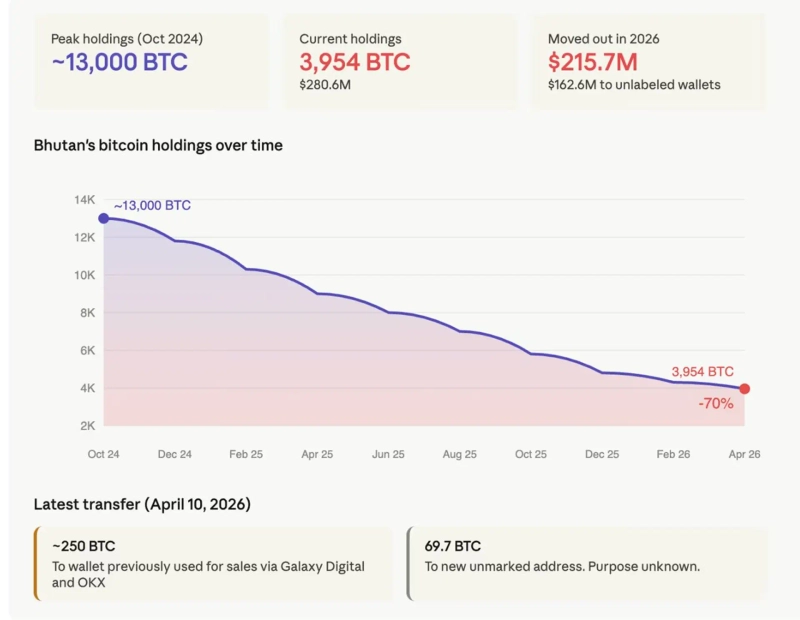
As a result, Bhutan became one of the few countries involved in crypto mining at a national level. At its peak, the country held around 13,000 BTC making it one of the largest government holders of Bitcoin in the world.
Steady Bitcoin Sales Since 2024
Since late 2024, Bhutan has been slowly selling its Bitcoin holdings. Data shows a clear and steady decrease in its total reserves over time. This means the country is reducing its investment step by step instead of selling everything at once.
Recent transactions support this trend. On April 10, Bhutan transferred around 250 BTC, worth about $18 million, to a wallet linked to earlier sales. It also moved another 69 BTC to a different address.
These are not one-time transactions. They are part of a larger pattern where Bitcoin is sent to platforms like Galaxy Digital and OKX, which are often used for selling large amounts of crypto.
So far, Bhutan has not shared any official reason for these sales, so experts are analyzing the data to understand its strategy.
Decline in Mining Activity Signals Strategic Shift
Bhutan’s Bitcoin mining activity appears to have slowed down or possibly stopped. Data from Arkham shows no major mining inflows (above $100,000) for more than a year. This clearly suggests that Bhutan is not producing new Bitcoin anymore and is instead selling from its existing holdings.
There are a few simple reasons behind this change. First, mining has become more expensive due to higher costs of electricity, infrastructure and advanced machines. Second, after the recent Bitcoin halving, mining rewards have reduced, which means lower earnings. Third, global mining competition has increased, making it harder to stay profitable.
Because of these challenges, continuing mining may no longer be a good option. As a result, Bhutan seems to be shifting its strategy from mining Bitcoin to selling its reserves for better financial stability.
Economic Factors Driving Bhutan’s Decision
Bhutan’s decision seems to be based on simple economic reasons. Instead of using hydropower to mine Bitcoin the country can sell that electricity to nearby countries like India. This can provide a more stable and regular income compared to the uncertain profits from crypto mining.
Bitcoin prices also keep changing and mining has become more difficult over time. After the recent Bitcoin halving, miners now earn fewer rewards, which reduces overall profit. On top of that, the cost of mining equipment and maintenance has increased.
Because of these factors mining Bitcoin may no longer be as profitable as before for Bhutan. While Bhutan is reducing its Bitcoin holdings, many large investors and institutions are still buying and holding Bitcoin, showing a different strategy in the market.