
Crypto expert and newsletter founder Lark Davis shared his view on the competition between Chainlink (LINK) and Ripple (XRP). He believes LINK could lead the crypto market in the next ten years.
Davis highlighted Chainlink’s advanced technology, especially its ability to connect different blockchains, which gives it a big advantage. On the other hand, XRP focuses mainly on banks and payments, limiting its daily use.
While XRP still attracts institutional investors, Davis thinks Chainlink’s wider applications and recent developments make it a stronger choice for long-term growth in the crypto space.
Why Lark Davis Backs Chainlink
In a Rollup TV interview, Lark Davis explained why he thinks Chainlink (LINK) is stronger than Ripple (XRP) for the long term. He focused on Chainlink’s Cross-Chain Interoperability Protocol (CCIP), which helps different blockchains work together easily. This makes LINK useful across many crypto networks, giving it more practical applications.
In contrast, XRP mainly focuses on payments and working with banks, which limits its everyday use. According to Davis, this wider functionality makes Chainlink a more powerful and versatile crypto asset, giving it an edge over XRP for future growth in the crypto market.
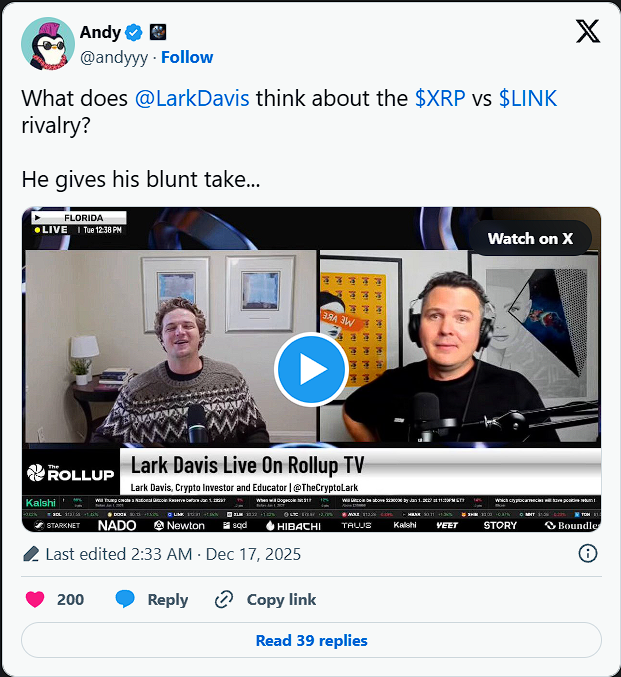
“I think Chainlink is an infinitely better asset than XRP Their CCIP technology is very persuasive,” Davis said. He also admitted he does not currently own LINK but sees its potential for substantial growth over the next decade.
Davis pointed out that Chainlink is not just connecting blockchains. It also bridges real-world assets with digital networks, allowing data and assets to move smoothly across systems. He added that recent partnerships and token buybacks have increased investor confidence in LINK.
The Limitations of XRP
Davis said that although XRP has a strong community and has been around for over ten years, it has some limitations. Its daily use is low, and its network mostly works within its own system. Ripple depends heavily on banks and big institutions, which can limit how widely the coin is used.
“XRP could still see upside if Ripple delivers on its long-term vision, but its ecosystem is less versatile compared to Chainlink,” he added.
Despite these criticisms, XRP continues to attract institutional interest. Spot XRP ETFs have surpassed $1 billion in inflows, highlighting ongoing confidence in the asset from investors.
LINK’s Expanding Use Cases
Chainlink is helping turn real-world assets into digital ones through new projects. For example, Coinbase’s Base network recently created a Solana bridge, making it easier to move assets across different blockchains. Also, the DTCC has received approval for a pilot program on digital assets, expected to start in the second half of 2026.
Chainlink has partnered with the U.S. Department of Labor to put important economic data on-chain, showing its growing role as a trusted system. Additionally, Grayscale’s Chainlink ETF (GLNK) gives investors a safe way to invest in LINK.
Two Different Models, One Conclusion
Lark Davis explains that LINK and XRP follow very different paths in the crypto world. XRP mainly focuses on payments and working with banks, while LINK acts as a neutral system connecting many blockchains and data networks. Because of this, Davis believes Chainlink is the stronger long-term investment, even though XRP may still grow within its own niche.
“Both can succeed in their areas, but LINK is much better positioned for the next decade,” he added.