
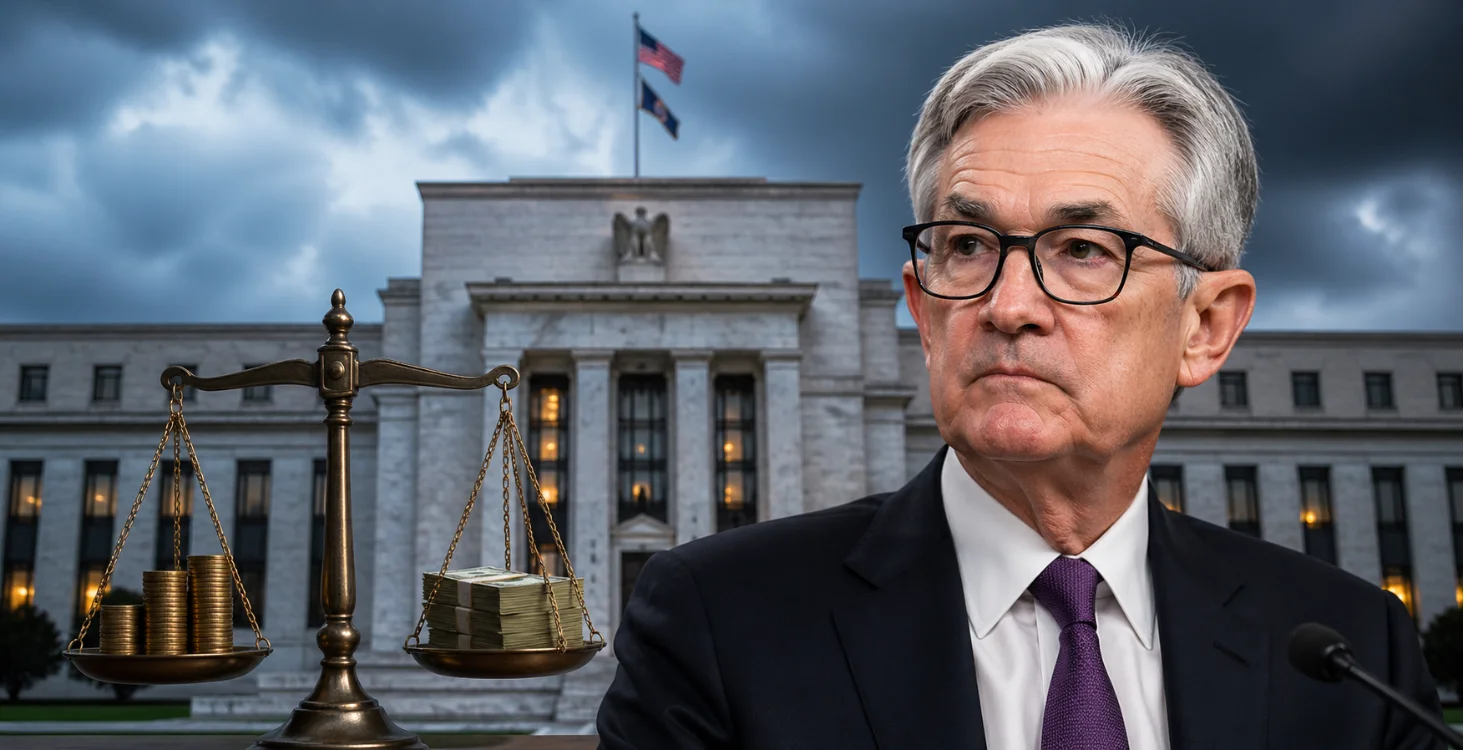
The Federal Reserve maintained its benchmark interest rates on Wednesday, keeping policy unchanged in a widely anticipated decision that had already been priced in by financial markets.
The pause comes as investors shift focus toward Federal Reserve Chair Jerome Powell, who may be presiding over his final Federal Open Market Committee (FOMC) press conference.
The central bank kept the federal funds rate target range unchanged at 3.5% to 3.75%, signaling that policymakers see no immediate need for adjustment as the U.S. economy continues to show resilience despite ongoing inflation pressures.
Economic Conditions Remain Stable, But Inflation Still Elevated
In its official statement, the Fed noted that recent economic indicators suggest continued solid expansion in economic activity. The labor market also remains stable, with job gains slowing but still positive on average.
Unemployment has not changed significantly in recent months, indicating that the broader employment picture remains steady.
However, inflation continues to remain above the Federal Reserve’s long-term target of 2%. Policymakers acknowledged that price pressures are still elevated, partly influenced by recent increases in global energy prices, which have added uncertainty to the inflation outlook.
The Fed reiterated its dual mandate, emphasizing its commitment to achieving maximum employment and stable prices, while continuing to monitor incoming data closely before making any future policy decisions.
Markets React with Calm as Decision Was Expected
Financial markets showed a muted reaction to the announcement, reflecting widespread expectations that interest rates would remain unchanged.
Bitcoin was trading near $76,000, showing little movement on the day. Major U.S. stock indexes also traded slightly lower, suggesting that investors had already priced in the Fed’s decision ahead of the announcement.
Analysts noted that the lack of volatility highlights how predictable the decision was, with traders now focusing more on forward guidance rather than the rate outcome itself.
Geopolitical Risks Add to Economic Uncertainty
In its statement, the Federal Reserve also highlighted growing geopolitical tensions, particularly developments in the Middle East.
According to policymakers, these events are contributing to heightened uncertainty in the global economic outlook, particularly in relation to energy markets and inflation expectations.
The Fed said it remains attentive to risks on both sides of its mandate, balancing concerns over inflation with the need to support continued economic growth and employment stability.
Powell’s Press Conference Now in Focus
Attention has now shifted to Federal Reserve Chair Jerome Powell, whose remarks after the policy decision are expected to offer important clues about the central bank’s future direction.
Traders and economists will closely watch his comments for signals on the inflation outlook in the coming months, as well as the strength and trajectory of the U.S. labor market. Market participants are also looking for insights into how energy-driven price pressures may influence overall inflation trends.
In addition, Powell’s guidance on the timing of any future interest rate changes will be under close scrutiny. His press conference carries added significance as it could be one of his final appearances as Fed Chair, depending on upcoming leadership transitions at the Federal Reserve.
Leadership Transition Adds Market Uncertainty
Adding another layer of uncertainty, the Senate Banking Committee voted on Wednesday to advance Kevin Warsh’s nomination as a potential successor to Jerome Powell.
Warsh’s nomination now moves to a full Senate vote, which could reshape expectations around future monetary policy direction.
The committee vote also reflected internal divisions. Stephen Miran opposed the decision, favoring a 25 basis point rate cut, while Beth Hammack, Neel Kashkari, and Lorie Logan supported keeping rates unchanged but disagreed with adding an easing bias to the policy statement.
This split highlights ongoing debate within the Federal Reserve system regarding the appropriate timing of monetary easing, especially as inflation remains above target and economic signals remain mixed.
Fed Reaffirms Data-Driven Approach
The Federal Reserve concluded its statement by emphasizing that it will continue to evaluate incoming economic data, evolving outlook conditions, and overall risk balance before making any further policy adjustments.
Officials reiterated their strong commitment to returning inflation to the 2% target level, while ensuring that employment conditions remain healthy and sustainable.